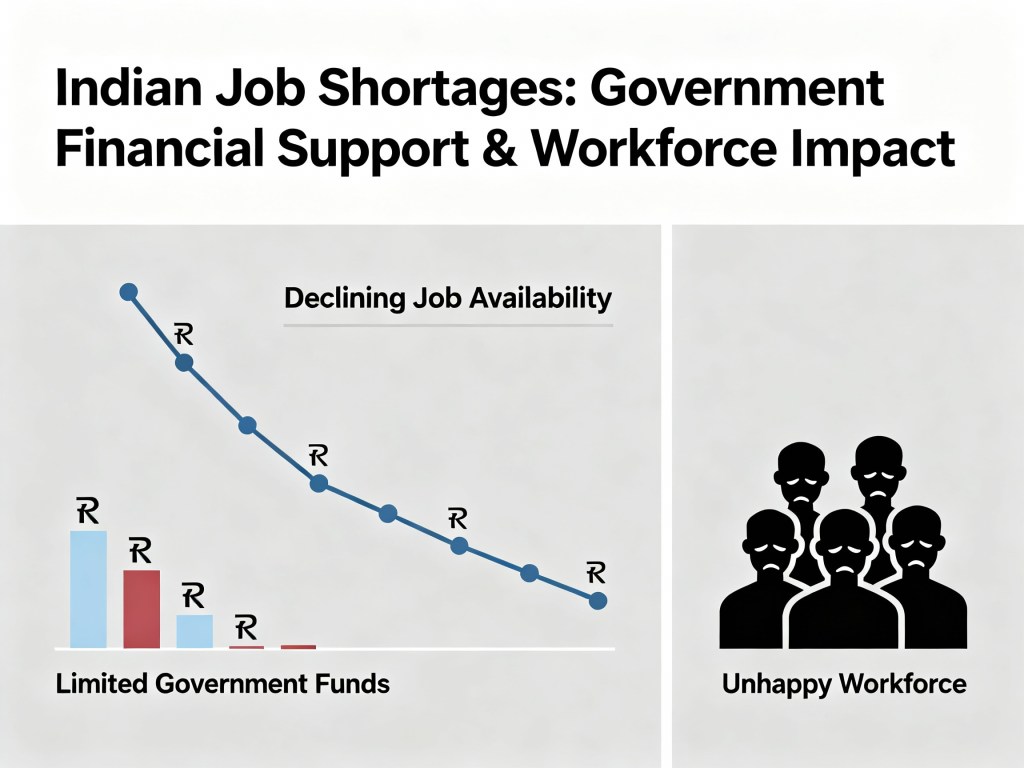
India faces significant job shortages, with the unemployment rate rising sharply in 2024–25 and government interventions often criticized as inadequate or misdirected��.
While several schemes have been launched—such as the Employment-Linked Incentive (ELI) Scheme and Production-Linked Incentive (PLI) Scheme—these are seen as benefiting large businesses more than directly supporting broad-based job creation or the informal workforce�.
Key Points on Job Shortages The unemployment rate reached 9.2% in June 2024, highlighting persistent job scarcity, especially for the youth and skilled workers��.
Despite India’s rapid GDP growth, employment generation has lagged, leading to a situation described as “jobless growth”�.
Sectors like manufacturing, traditionally expected to absorb labor, have seen their employment contribution stagnate or decline despite large government outlays��.
Government Financial Support Mechanisms Recent budgets have allocated large sums for job-linked schemes—over ₹2 lakh crore was announced for youth employment in 2024–25�.
Flagship programs like ELI and PLI provide wage subsidies and incentives to private employers but only a fraction of the promised jobs have materialized; for example, PLI created only 7 lakh jobs out of a promised 60 lakh�.
The Mahatma Gandhi National Rural Employment Guarantee Act (MGNREGA) remains the only scheme providing guaranteed jobs to rural households, but it faces consistent underfunding and shrinking coverage��.
Other initiatives such as Start-Up India, PMKVY (skill training), and direct benefit transfers exist, but the scale of government intervention has not matched the vast numbers of unemployed���.
Limitations and Criticism Most government schemes are indirect and target business incentives rather than mass hiring; direct unemployment allowances are rare and modest in size��.
Core welfare and rural employment schemes see stagnant or reduced budgets, shifting the focus to corporate subsidies over social infrastructure�.
The use of institutions like the Employees’ Provident Fund Organisation (EPFO) for employment subsidies has been criticized as a misallocation of funds meant for worker welfare�.
Trade unions and economists argue that real solutions require sustained investment in labor-intensive sectors and stronger social protection, not just employer incentives�.
India’s job shortage crisis is therefore intertwined with insufficient and misdirected financial support, where ambitious announcements contrast with limited on-ground impact and weak direct aid for the unemployed��.

Leave a comment