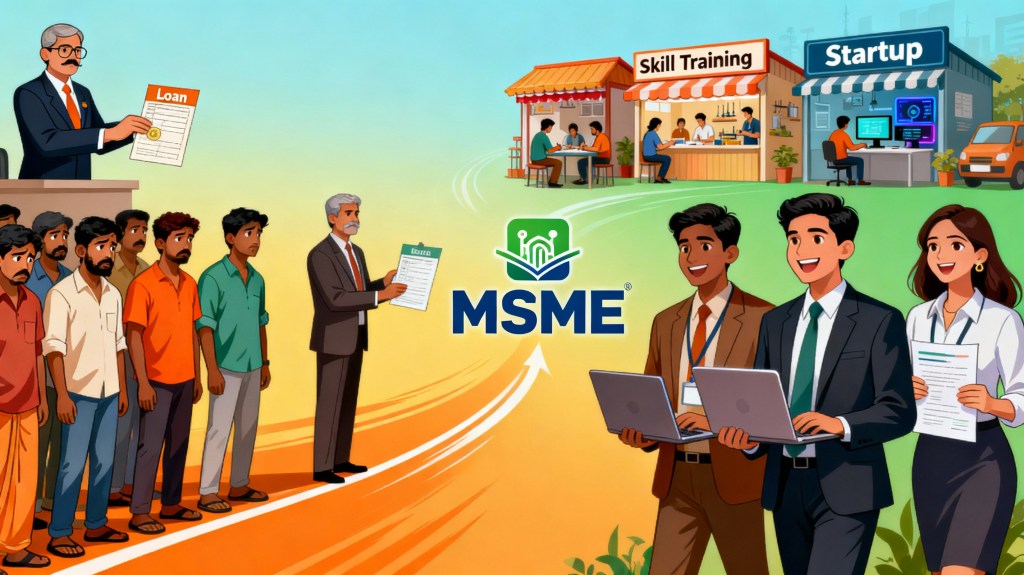
Indian government data and policy documents say that limited growth in formal wage jobs is one major reason more Indians are turning to self-employment and startups, but they present this as a “structural shift” supported by schemes rather than simply a crisis of unemployment.��
Officially, self-employment is framed as both a response to job shortages and a deliberate strategy to create more flexible, entrepreneurial livelihoods.��
Evidence from government data. Periodic Labour Force Survey (PLFS) data cited by the Labour Ministry shows self-employment in total workforce rising from about 52.2% in 2017–18 to around 58.4% in 2023–24, while casual labour falls, which the government describes as movement toward “entrepreneurial and independent work.”���
Economic Survey and press notes highlight that more than half of India’s workforce is now self-employed, and this trend has strengthened in recent years as formal job creation has not fully matched the expanding working-age population.��
How government explains the shift Policy documents (NITI Aayog, MSME and Employment Ministry notes) stress that wage employment alone cannot absorb India’s large young labour force, so promotion of self-employment and entrepreneurship is “essential” for job creation.��
Government communication links rising self-employment to programs like Skill India, Make in India, Startup India, and the focus on MSMEs, portraying entrepreneurship as a planned pillar of employment strategy, not just a fallback.���
Schemes pushing self-employment Pradhan Mantri Mudra Yojana (PMMY) gives collateral‑free loans up to ₹10 lakh specifically to micro‑entrepreneurs, and is repeatedly cited in official employment reports as a key self‑employment facilitator.�
Other cited schemes include PMEGP, women’s SHG/entrepreneurship programs, Atal Innovation Mission, and SETU, all explicitly justified as ways to generate jobs by encouraging people to start micro and small enterprises instead of waiting for salaried posts.���
Startups as job creators DPIIT and PIB notes say India now has around 1.5–1.9 lakh recognised startups, creating more than 17 lakh direct jobs, and they are showcased as proof that entrepreneurship and innovation are absorbing part of the job pressure.��
Government narratives present startups and the broader gig/platform economy as new avenues for youth employment, especially when traditional manufacturing and public-sector hiring cannot provide enough opportunities.���
How “reason” is framed officially In official language, the “reason” for promoting self-employment and startups is that conventional job creation alone cannot meet India’s employment challenge, so people must be supported to “create their own jobs” through enterprises.��
At the same time, some analytical and academic reports noted by government channels caution that part of this rise in self-employment is in low‑productivity or unpaid family work, which suggests underemployment and lack of quality wage jobs also push people into such roles.��

Leave a comment