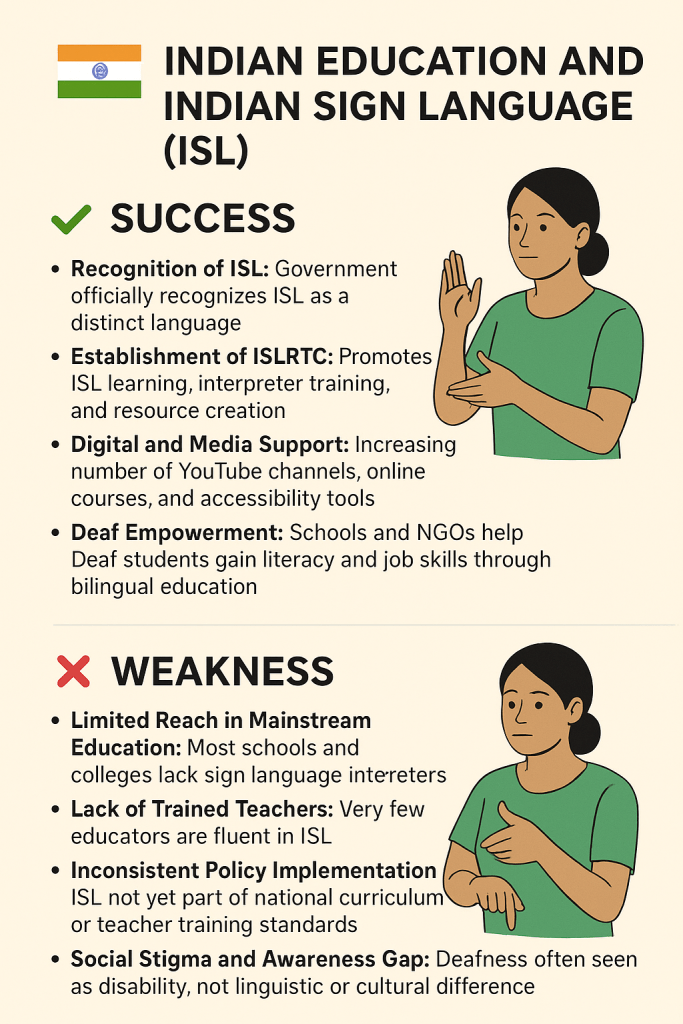
Here’s a balanced summary of Indian education using Indian Sign Language (ISL) — highlighting both its successes and weaknesses:
🇮🇳 Indian Education and Indian Sign Language (ISL)
Successes:
- Recognition of ISL:
The Government of India officially recognized Indian Sign Language (ISL) as a distinct language, marking a major step toward inclusion. - Establishment of ISLRTC:
The Indian Sign Language Research and Training Centre (ISLRTC) promotes ISL learning, interpreter training, and resource creation. - Digital and Media Support:
Increasing number of YouTube channels, online courses, and accessibility tools (like sign language interpreters on TV and news) are raising awareness. - Deaf Empowerment:
Schools and NGOs are helping Deaf students gain literacy and job skills through bilingual education — ISL plus written/spoken English or Hindi.
Weaknesses:
- Limited Reach in Mainstream Education:
Most schools and colleges lack sign language interpreters, leaving Deaf students dependent on lip-reading or isolated learning. - Lack of Trained Teachers:
Very few educators are fluent in ISL, and special education training programs remain underdeveloped. - Inconsistent Policy Implementation:
Although ISL is recognized, it’s not yet part of the national curriculum or teacher training standards in most states. - Social Stigma and Awareness Gap:
Many still see Deafness as a disability rather than a linguistic or cultural difference, limiting inclusive practices.
🟢 Summary:
Indian education’s inclusion of Indian Sign Language shows progress in recognition and advocacy, but true educational inclusion remains weak due to limited access, training, and policy execution. It’s a partial success with systemic challenges still to overcome.
Would you like me to tur


Leave a comment