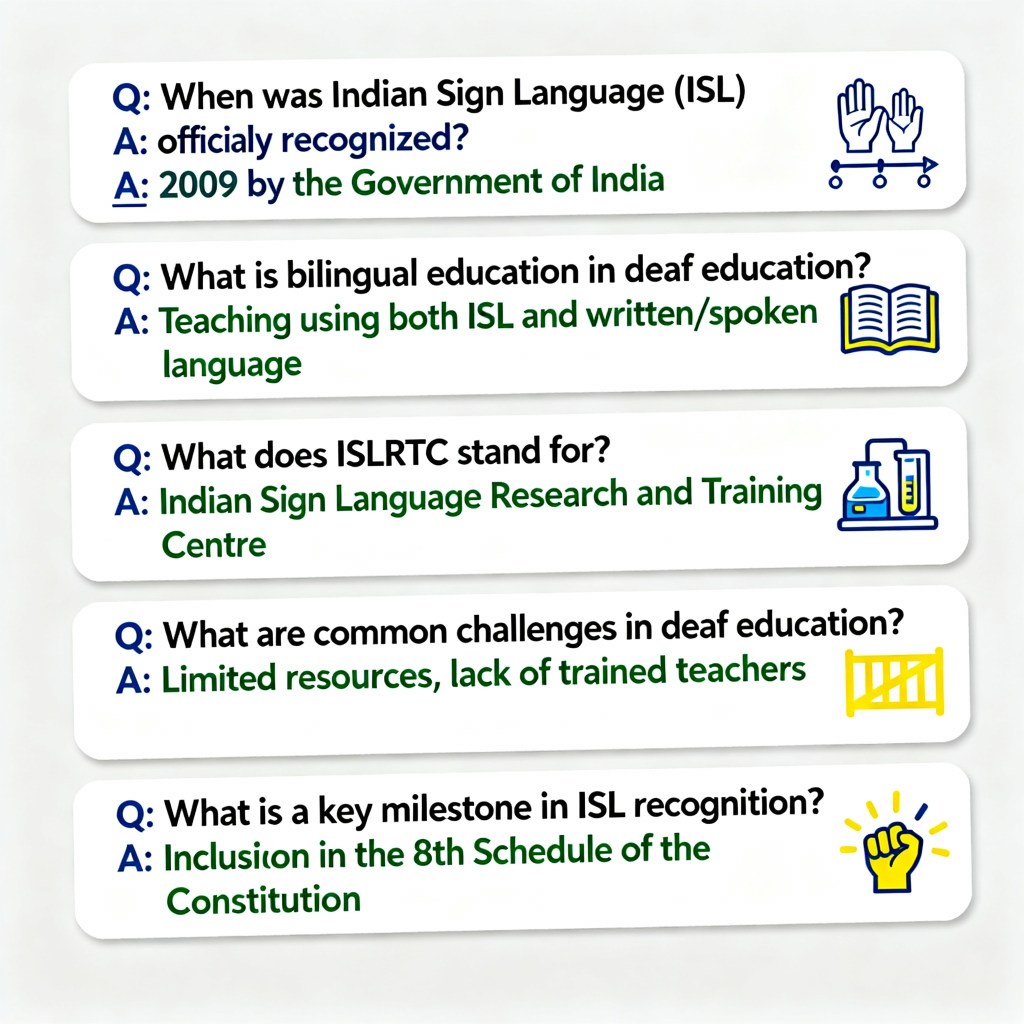
Here is a tailored set of flashcards focused on deaf education using Indian Sign Language (ISL):
Flashcards: Deaf Education Using Indian Sign Language (ISL)
Q1: What is Indian Sign Language (ISL)?
A1: ISL is a natural visual language used by the Deaf community in India with its own grammar, syntax, and vocabulary, distinct from spoken Indian languages �.
Q2: When did formal education for deaf children start in India?
A2: Formal education began in 1885, but widespread use of ISL in education is more recent, with ISL formally taught only since 2001 through specific training programs �.
Q3: What role did Mook Badhir Sangathan (MBS) play in ISL education?
A3: Founded in 1974 in Indore by a deaf couple, MBS promoted the free and fluent use of ISL in education, contrasting with the mostly oral approach in other schools �.
Q4: What is the Indian Sign Language Research and Training Centre (ISLRTC)?
A4: Established in 2015 under the Ministry of Social Justice and Empowerment, ISLRTC develops ISL resources, trains teachers/interpreters, and promotes bilingual education materials ��.
Q5: Why was the use of ISL discouraged historically in Indian deaf education?
A5: Oralism was preferred due to influences from British and American oral training programs, with sign language often seen as mere gestures, not a language �.
Q6: What educational challenges does Indian deaf education face regarding ISL?
A6: Many schools do not use ISL as the medium of instruction, and most teachers are hearing and not trained in ISL, limiting communication and learning for deaf students ��.
Q7: What are some major milestones in the development of ISL courses?
A7: The first formal ISL training course started in 2001 at the Ali Yavar Jung National Institute; a comprehensive ISL dictionary was published in 2001; and IGNOU started a B.A. in Applied Sign Language Studies in 2009 �.
Q8: How has the Deaf community influenced ISL education in India?
A8: Through advocacy, protests, and campaigns leading to the establishment of ISLRTC and increased awareness of ISL’s importance in education and communication ��.
Q9: What is the significance of bilingual education in ISL?
A9: It promotes teaching both ISL and the national spoken/written language, bridging deaf and hearing worlds and supporting identity and learning �.
Q10: What resources are available to support deaf education with ISL?
A10: ISL dictionaries, interpreter training courses, bilingual instructional materials, and organizations like ISLRTC and Mook Badhir Sangathan support education and community ��.
These flashcards cover history, key institutions, teaching challenges, and cultural aspects of Indian Sign Language in deaf education. They can be used for study or training purposes. If needed, they can be formatted as printable cards or digital flashcards for apps.This selection reflects the unique Indian context of deaf education with ISL as a medium, highlighting ongoing challenges and progress ����.

Leave a comment