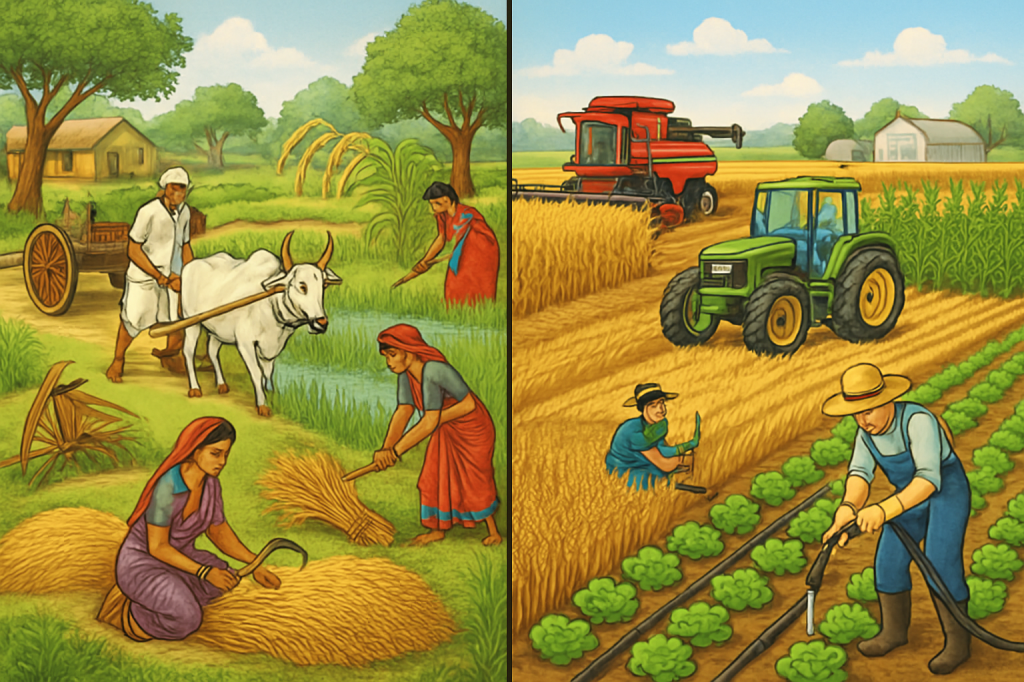
Most Indian farmers still largely rely on traditional farming practices, although the adoption of modern, technology-driven farming is steadily increasing in recent years, driven by government schemes and market forces.
Traditional Farming in India
Traditional farming in India uses indigenous seed varieties, crop rotation, organic manure like cow dung, and manual labor with minimal technology. Water harvesting techniques, composting, mixed cropping, and reliance on monsoon rains are characteristic features, which help sustain soil health and preserve agricultural biodiversity. Roughly 96% of Indian farmers continue to use traditional practices as their main approach, relying heavily on local knowledge and natural rhythms.
Modern Farming Adoption
Modern farming in India is characterized by mechanization (tractors, harvesters), use of genetically modified and high-yield seeds, chemical fertilizers, precision agriculture (drones, IoT sensors, AI), and smart irrigation systems. These techniques greatly boost productivity and efficiency but require significant investment in equipment and training. The proportion of farmers adopting modern methods remains relatively small; less than 15% have fully integrated sustainable or modern farming practices by 2024, although trends show steady growth driven by government initiatives and increasing awareness.
Data and Trends
Traditional: Roughly 95% of Indian farmers mainly use traditional practices as of early 2025.
Modern: Sustainable and technology-driven approaches are adopted incrementally, with precision farming, mechanization, and biotech gaining ground, but full modern adoption is under 15% among all farmers.
Drivers and Barriers: Government subsidies, training, and market incentives encourage modern practice, but affordability, climate risk, and insurance limitations remain major barriers.
Table: Comparison of Farming Methods in India
In summary, traditional farming remains dominant among Indian farmers due to cultural roots and accessibility, while modern farming methods are gradually spreading as technology and government support expand.

Leave a comment