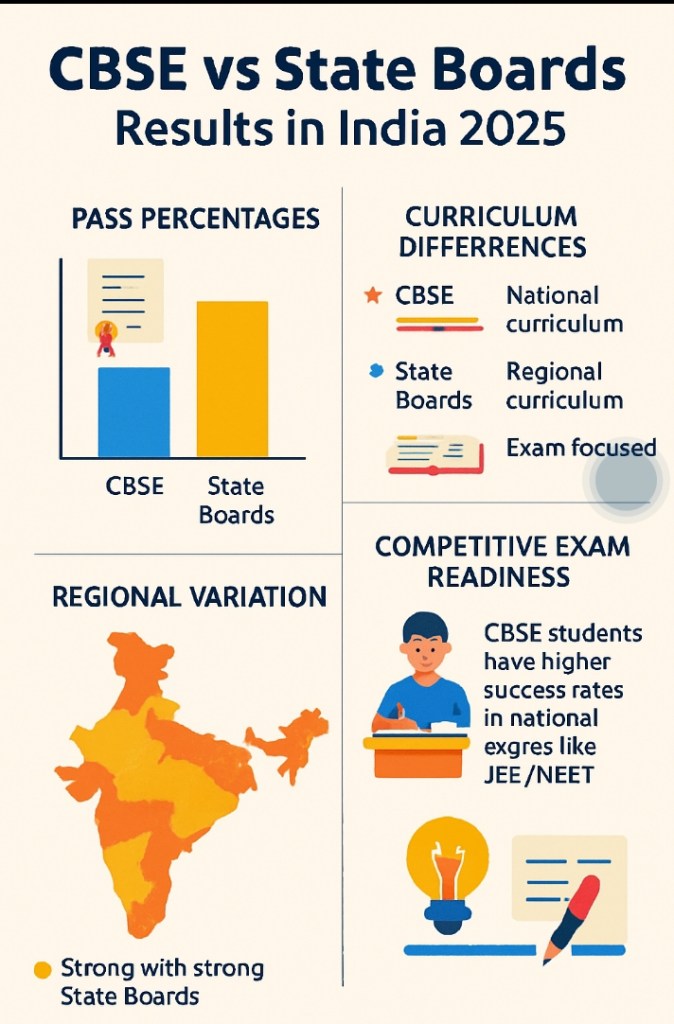
Analysis: Indian Students’ Results – CBSE vs State Boards (2025)Pass Percentages & Academic Outcomes
CBSE Results 2025:
Class 10 pass percentage: 93.66%.
Class 12 pass percentage: 88.39%.
Girls consistently outperform boys (gap of 2.37% for X and nearly 6% for XII).Transgender students in CBSE saw a 100% pass rate in XII and 95% in X.
Top regions: Vijayawada (99.60%), Trivandrum (99.39%), Chennai (97.39%), Bengaluru (95.95%).
Pass rates are uniformly high in metro/urban centres.
State Boards Results 2025:Pass percentages vary widely across states, often ranging 80–98% in best-performing states but dipping to 60–75% in some low-performing or resource-challenged states.
Many state boards have more lenient marking or less rigorous, rote-focused assessments. In states like Tamil Nadu, Maharashtra, and Kerala, average pass rates often rival CBSE, but the focus is less on analytical skills.Curriculum and evaluation standards differ, leading to inconsistencies and highly variable pass rates year-on-year and by region.
Curriculum & Exam Patterns
Observations & Impact
- CBSE students generally fare better in national-level competitive exams (JEE, NEET, UPSC) due to the standardized, analytical syllabus. They have higher mobility across states and for international admissions.
- State Board students excel in localized/regional subjects but may struggle when shifting to national curriculum or competitive environments.
- The disparity in results and preparedness is reflective of India’s educational diversity: CBSE ensures uniformity and rigor, while State Boards focus on regional relevance and accessibility.
- The overall difference in results is not just about pass percentages, but quality and readiness for higher studies, problem-solving, and employment. CBSE students tend to have an edge in these areas due to broader exposure and rigorous assessment patterns.
Conclusion:
CBSE students typically achieve higher pass rates and are better prepared for national-level exams due to a uniform, concept-driven curriculum, while State Board results and outcomes vary widely depending on the state’s resources, focus, and assessment patterns. For students aspiring to competitive exams and higher mobility, CBSE offers significant advantages, while State Boards may better serve those seeking regional relevance and flexibility.

Leave a comment