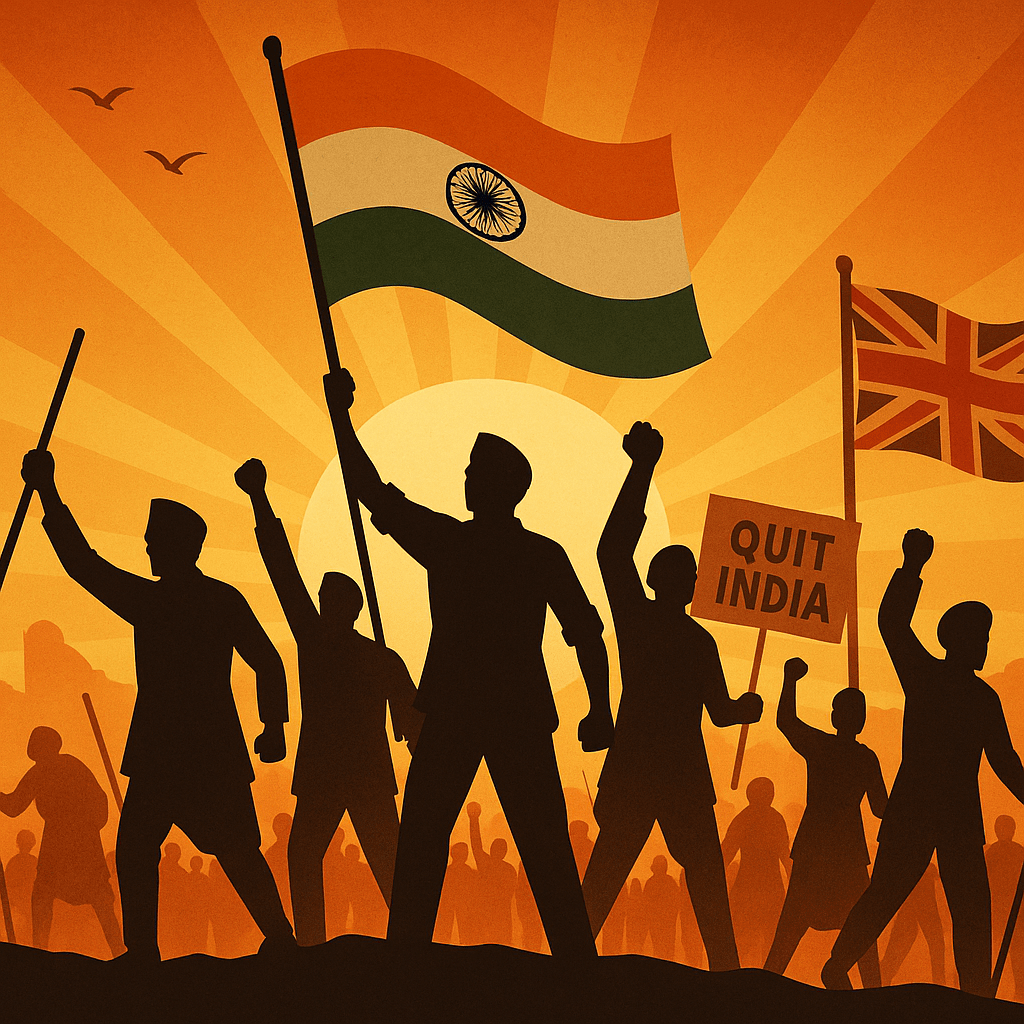
India’s freedom from British rule on 15 August 1947 was the result of decades of struggle by countless freedom fighters—men and women who risked or sacrificed their lives to achieve independence.
Here’s a concise yet rich overview:
Background
- British rule in India began formally in 1858 after the suppression of the First War of Independence (1857).
- For nearly 90 years, Indians faced economic exploitation, racial discrimination, and political subjugation.
- Freedom fighters emerged from all regions, communities, and ideologies—some advocating nonviolence, others choosing armed resistance.
Key Phases of the Freedom Struggle
- Early Resistance (1857–1905)
- Mangal Pandey, Rani Lakshmibai, Tatya Tope — leaders of the 1857 uprising.
- Formation of the Indian National Congress (1885) to demand reforms.
- Social reformers like Dadabhai Naoroji and Bal Gangadhar Tilak spread nationalist ideas.
- Partition of Bengal & Swadeshi Movement (1905–1911)
- British partitioned Bengal to weaken nationalism.
- Leaders like Bipin Chandra Pal, Lala Lajpat Rai, Aurobindo Ghosh urged boycott of British goods.
- Gandhian Era (1915–1942)
- Mahatma Gandhi introduced Satyagraha and Ahimsa (nonviolence).
- Movements: Non-Cooperation (1920–22), Civil Disobedience (1930), Quit India (1942).
- Leaders like Jawaharlal Nehru, Sardar Vallabhbhai Patel, Maulana Abul Kalam Azad worked alongside Gandhi.
- Revolutionary Struggle
- Bhagat Singh, Rajguru, Sukhdev — fought against British oppression with armed rebellion.
- Subhas Chandra Bose led the Indian National Army (INA) to militarily challenge British power.
- Naval Mutiny & Last Push (1946–47)
- Royal Indian Navy Mutiny and growing unrest among soldiers and civilians convinced the British that their rule was unsustainable.
- Negotiations led to the Indian Independence Act of 1947.
Notable Freedom Fighters
- Mahatma Gandhi – Father of the Nation, champion of nonviolence.
- Subhas Chandra Bose – Led INA, coined “Jai Hind”.
- Bhagat Singh – Symbol of youth revolution.
- Sardar Vallabhbhai Patel – Unifier of India’s princely states.
- Jawaharlal Nehru – First Prime Minister of independent India.
- Rani Lakshmibai, Mangal Pandey, Lala Lajpat Rai, Bipin Chandra Pal, Annie Besant, Gopal Krishna Gokhale, and many more.
Outcome
- 15 August 1947 — India became independent.
- Pakistan was created as a separate nation.
- The British left, ending nearly 200 years of colonial rule.

Leave a comment