National Overview
- As of 2019-20, women comprised around 19.7% of India’s formal manufacturing workforce—about 1.6 million out of 8 million factory workers.
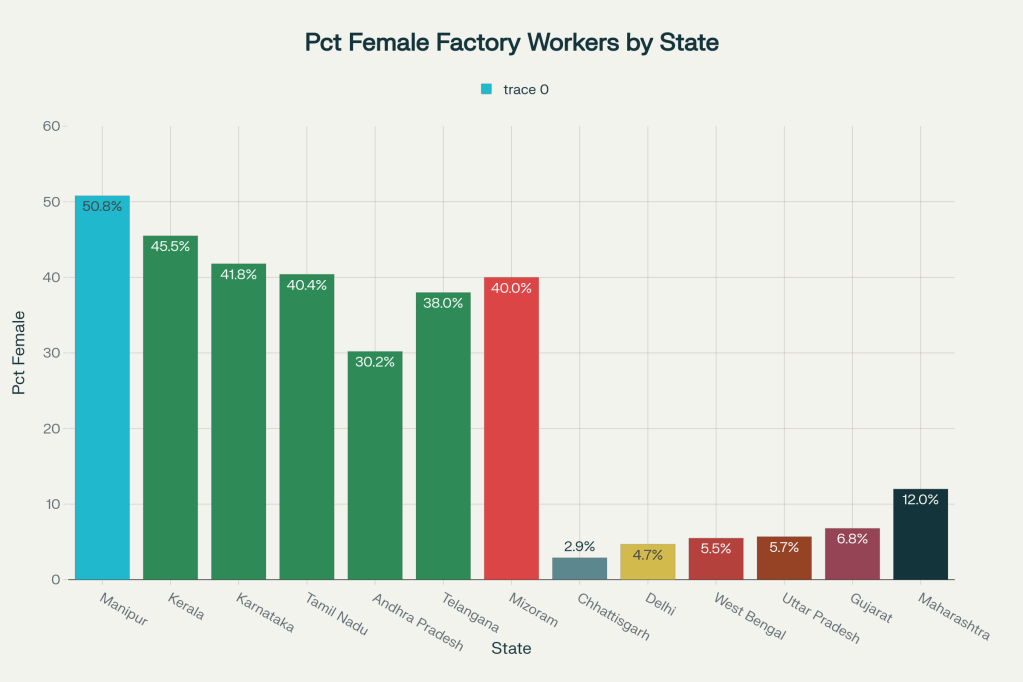
- There are stark regional disparities in the distribution of female factory workers; southern states employ a disproportionately high share.
Statewise Patterns
States with the Highest Share of Female Factory Workers
| State | % Female in Manufacturing Workforce (2019-20) | Notable Facts |
|---|---|---|
| Manipur | 50.8% | Only state with a near gender-balance in factories |
| Kerala | 45.5% | Strong presence in textiles and food processing |
| Karnataka | 41.8% | Major employer in textiles and manufacturing |
| Tamil Nadu | 40.4% | Houses 42-43% of all women factory workers in India |
| Andhra Pradesh | 30.2% | Notable share, especially in textiles and food processing |
- Tamil Nadu employed approximately 6.3 lakh (630,000) women in 2021-22, accounting for 42-43% of the entire female factory workforce in India.
- Nearly three-fourths (72%) of all women working in factories are employed in the four southern states: Tamil Nadu, Karnataka, Andhra Pradesh, and Kerala.
- Other states with significant shares include Telangana and some Northeastern states (e.g., Manipur, Mizoram) where the female share can exceed 40%.
States with Low Female Representation
| State/Region | % Female in Manufacturing Workforce |
|---|---|
| Chhattisgarh | 2.9% |
| Delhi | 4.7% |
| West Bengal | 5.5% |
| Uttar Pradesh | 5.7% |
| Gujarat | 6.8% |
| Maharashtra | 12% |
- In 16 states and union territories, women comprised less than 10% of manufacturing employees.
- Highly industrialized states like Maharashtra, Gujarat, and Uttar Pradesh have large gender gaps in factory employment.
Industry Segmentation
- Textiles and apparel: Main sectors employing women in manufacturing; especially pronounced in the South.
- Tobacco: In West Bengal, Jharkhand, and Telangana, tobacco manufacturing is the second largest employer of female manufacturing workers.
- Pharmaceuticals: Particularly important in Goa and Sikkim.
- Food processing: A major sector for women in Kerala and Meghalaya.
- Brick production: Key employer in Chhattisgarh.
- In Delhi, about 25% of women in manufacturing work in vehicle and equipment manufacturing.
Trends and Insights
- The share of women in formal sector factories has remained relatively static at 19-20% over two decades.
- Despite industrial growth, gender gaps persist, especially in northern and western industrialized states.
- The trend of feminization of industrial labor is more prominent in some states, reflecting increasing numbers or proportions of women in manufacturing jobs over recent years.
- Many women also participate in the informal manufacturing sector, particularly in low-paying, low-skilled, and insecure jobs, constituting about 43% of the informal workforce in this sector.
Factors Explaining State Differences
- Southern States: Higher female factory participation is linked to strong tradition in textiles/apparel, proactive state policies, community and SHG movements, and more inclusive workplace norms.
- Northeastern States: Matrilineal cultures and smaller, community-oriented manufacturing also boost participation rates for women.
- Low-participation States: Gender norms, low industrialization in traditional sectors employing women, and lack of policy focus limit women’s factory employment.
Wage Disparities
- Across India, female industrial workers earned about INR87.06 for every INR100 earned by male counterparts in 2019-20, highlighting a persistent gender wage gap.
Key Takeaways
- Southern states—especially Tamil Nadu, Karnataka, Kerala, and Andhra Pradesh—are the engines of female factory employment in India, accounting for the bulk of all women factory workers.
- A few industries dominate female employment (textiles/apparel, tobacco, food processing), with significant regional and sectoral variation.
- The gender gap in manufacturing is narrowing only slowly, underscoring ongoing challenges around workplace inclusivity, pay equity, and access to high-skilled roles for women.

Leave a comment