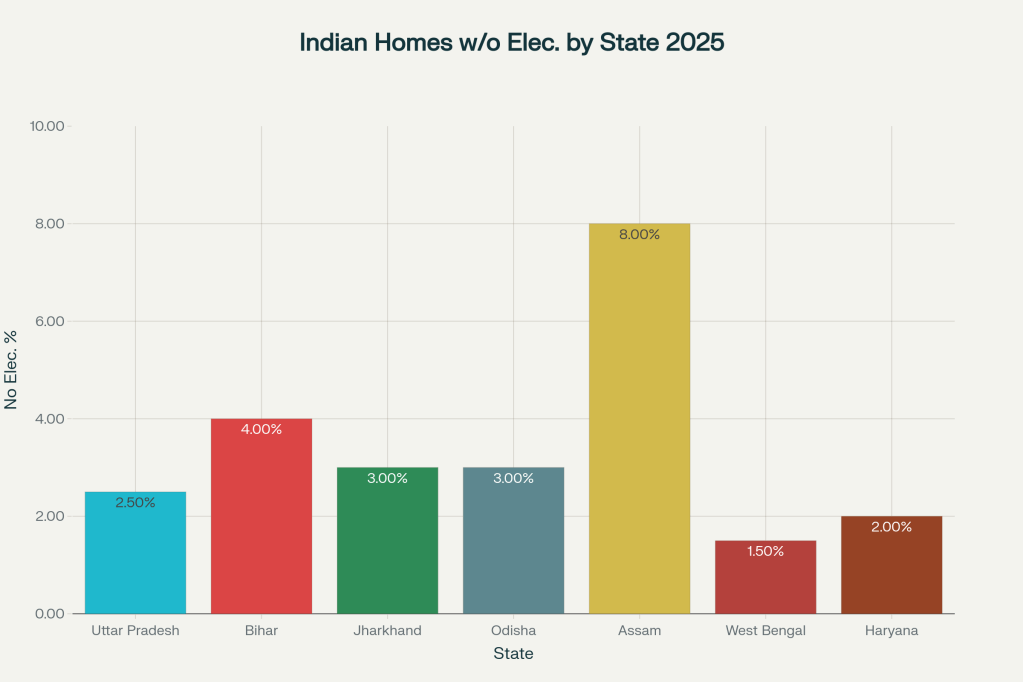
Analysis of Indian Homes Without Electricity, by State (2025)
Nationwide Overview
India has made significant strides towards universal household electrification over the past two decades. As of 2021, 99.6% of India’s population had access to electricity, up from just 60% in 2000. By mid-2025, household electricity access in most states exceeds 95%[1][2]. However, some states—and particularly rural and marginalized areas—still lag behind in full coverage.
State-Wise Situation
States/UTs With Near-Universal Access
- Goa, Telangana, Kerala, Andhra Pradesh, Karnataka, Lakshadweep, Dadra and Nagar Haveli and Daman and Diu, Jammu and Kashmir, Ladakh, Sikkim: At least 99% of the population lives in electrified homes[2].
- Bihar: Increased household electrification from 17% in 1993 to 96% by 2019–21[1].
- Assam, Odisha, West Bengal: Significant progress, now at or above 90% electrification[1][2].
States With Remaining Gaps
Despite advances, a small but important percentage of homes in some states remain unelectrified. States where this is more prevalent (primarily in rural or difficult-to-reach regions):
| State | Estimated % Households Without Electricity (2020–2025) | Key Details |
|---|---|---|
| Uttar Pradesh | ~2–3% (in 2020, 60% in rural areas had access) | Faces daily power outages; rural areas especially affected[3][4][5]. |
| Bihar | ~4% (as of 2021) | Substantial improvement, but rural quality and reliability issues persist[1][2][3][5]. |
| Jharkhand | ~2–4% | Longest outages in rural regions; 67% households electrified as of 2015[3][6][5]. |
| Odisha | ~2–4% | Progress at village level, but household access just over 90% in some districts[5]. |
| Madhya Pradesh | ~2% | Most homes electrified; some rural communities still without full service[4][5]. |
| Assam | ~8% rural homes without electricity (2021) | Marked improvement, but rural regions still lag[1][2]. |
| West Bengal | ~1–2% | Almost 93% of households had access in 2015; now near-universal access[3][5]. |
| Haryana | ~2% | Some rural districts report higher outage durations[6][4]. |
- Survey data for 2024–2025 suggests the remaining unconnected households primarily belong to remote, tribal, or economically disadvantaged groups, as well as “last mile” rural areas[7][1][2].
- About 2.4% of Indian households were without electricity as of 2020, concentrated in north-central states and rural zones[4].
Villages Without Electricity
Progress is also measured at the village level:
- As of July 2025, a small number of villages remain unelectrified, with most states reporting single- or double-digit figures—often fewer than 100 villages per state, and sometimes as few as 0–1 villages out of thousands[7].
Quality, Reliability, and Hidden Gaps
- Household Connection vs. Actual Supply: Even with connections, many households experience regular outages, voltage instability, and supply limited to a few hours per day—especially in Uttar Pradesh, Jharkhand, Assam, Bihar, and Haryana[6][4].
- Urban-Rural Divide: Urban areas enjoy nearly universal and more reliable access, while rural areas still face intermittent supply[2][6].
- Affordability & Demand: Many households avoid connections or forgo usage due to connection costs or unreliable supply, even when the grid is available[3].
Summary Table: Key States With Notable Gaps (2025)
| State | Estimated % Homes Without Power | Notes |
|---|---|---|
| Uttar Pradesh | 2–3%[4][5] | Rural outages, affordability barriers |
| Bihar | 4%[1][2][5] | Significant progress, supply quality issues |
| Jharkhand | 2–4%[3][6][5] | Long outages in rural areas |
| Odisha | 2–4%[5] | Difficult terrain, tribal areas |
| Assam | 8% (rural)[1][2] | Rural regions behind urban |
| West Bengal | 1–2%[3][5] | Among best-performing large states |
| Haryana | ~2%[6][4] | Intermittency in some districts |
Conclusion
While India approaches universal household electrification, a small minority—primarily in select rural pockets of north-central and eastern states—remains unelectrified. Quality of supply and affordability continue to be challenges, with regular and reliable power still not universal in some regions.

Leave a comment