Analysis of Indian Homes Without Toilets (State-Wise)
National Overview
Despite significant progress in sanitation, millions of Indian households still lack access to toilets. Data from the National Family Health Survey (NFHS) 2019–2021 reveals:
19.4% of Indian households do not use any toilet facility.The rural-urban divide is notable:
25.9% of rural households lack toilets versus 6.1% in urban areas.
The worst-affected are often in the poorest wealth quintile and disproportionately in rural regions.
States With the Highest Share of Households Without Toilets
Several states lag far behind the national average in toilet coverage:
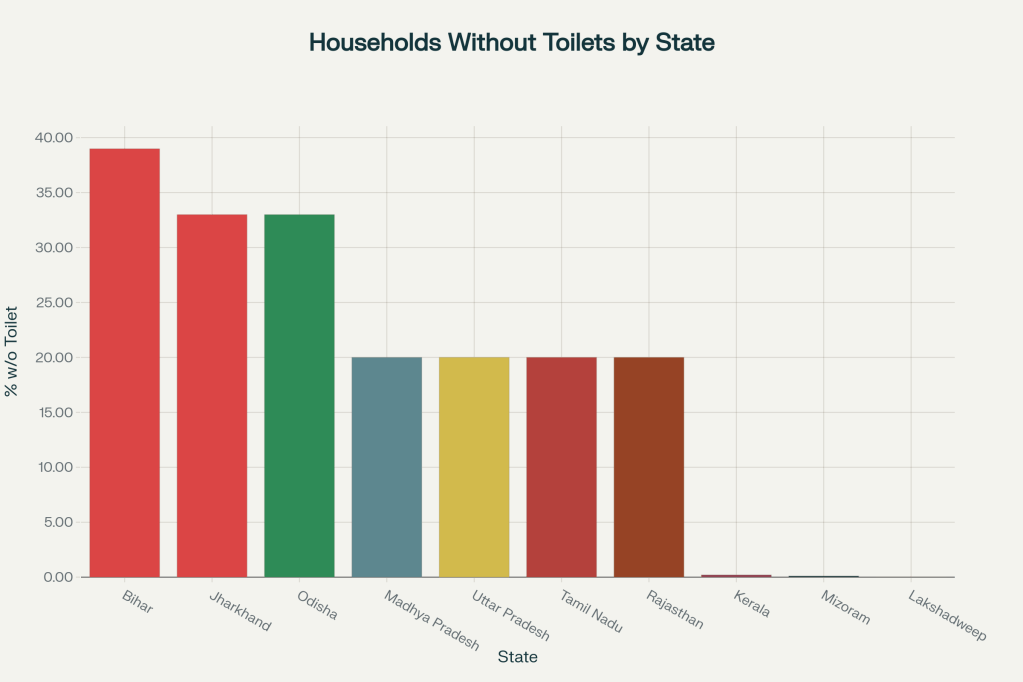
State % Households Without Toilets (approx)
Bihar Nearly 39%
Jharkhand Around 33%
Odisha Around 33%
Madhya Pradesh Over 20%
Uttar Pradesh Over 20%
Tamil Nadu Over 20%
Rajasthan Over 20%
Bihar has the worst access, with only 61.2% households reported to have toilet facilities.
Jharkhand (69.6%) and Odisha (71.3%) also perform poorly.
The situation is far better in Kerala, Mizoram, and Lakshadweep, where nearly 100% of households have toilets.Regional Disparities
Rural Areas: 90% of households that do not use a toilet are rural.
Top Four States: Over half of India’s households forced to defecate in the open are located in Uttar Pradesh, Bihar, Maharashtra, and Tamil Nadu.
Wealth Disparity: Most households without toilets are from the poorest sections, especially in urban slums.
Trend Over Time In 2015–16, about 39% of Indian households practised open defecation; this dropped to 19.4% by 2021.
Interventions under the Swachh Bharat Mission and other programs have dramatically increased access to toilets, but gaps remain, particularly in the poorest and most rural states.
Best-performing states are in the south and northeast, especially Kerala, Lakshadweep, and Mizoram.
Majority rural problem: The vast majority of Indian homes without toilets are in rural areas and among the poorest.
Policy Implications Efforts need to prioritize:Lagging states (Bihar, Jharkhand, Odisha, UP, MP, Rajasthan, Tamil Nadu).
Rural households and the poorest urban areas.Sustained behavioral change in addition to infrastructure.Monitoring and verifying the actual use of built toilets, not just their construction.India’s drive for universal toilet access has made remarkable gains, but state-wise data shows the challenge is far from over. Sustained focus is essential to meet the goal of complete sanitation coverage.
Make a one-time donation
Make a monthly donation
Make a yearly donation
Choose an amount
Or enter a custom amount
Your contribution is appreciated.
Your contribution is appreciated.
Your contribution is appreciated.
DonateDonate monthlyDonate yearly
Leave a comment