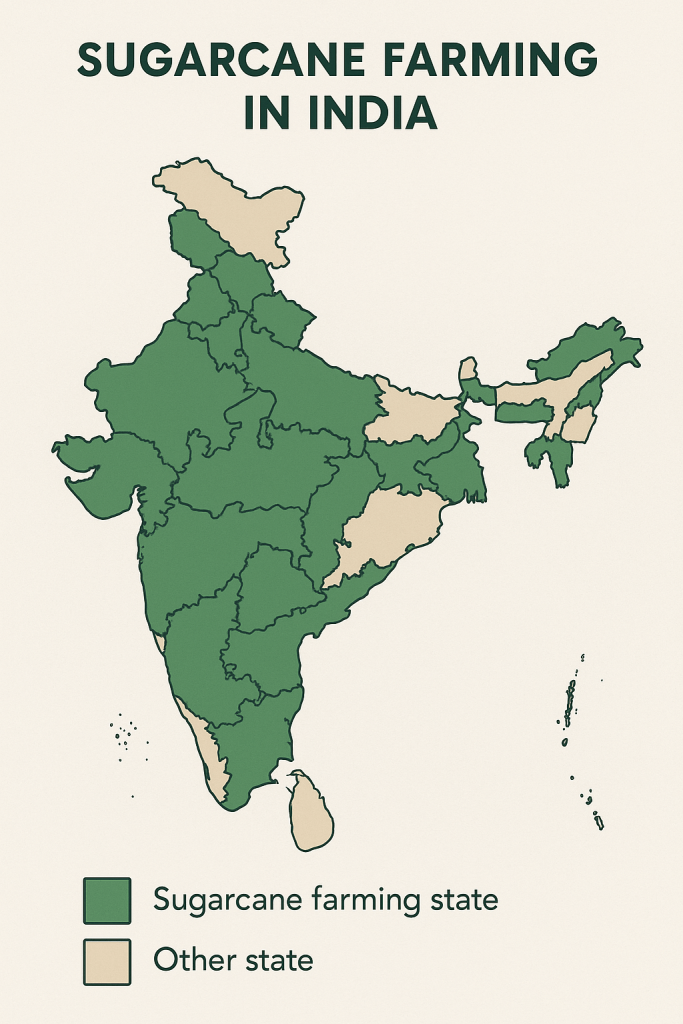
Sugarcane farming in India is geographically diverse, with distinct production patterns and efficiencies across states. The cultivation is broadly classified into tropical and sub-tropical regions, each home to prominent sugarcane-producing states, and exhibits notable differences in area, production, and productivity.
Major Sugarcane Producing States
- Uttar Pradesh: Largest producer, contributing approximately 47% of India’s sugarcane production (about 177 million tonnes in 2017-18). It also has the highest area under sugarcane cultivation, with over 2.23 million hectares. While the area and overall output dominate, its productivity (yield per hectare) is close to the national average.
- Maharashtra: Second by production (22% share, ~83 million tonnes in 2017-18), with 900,000 hectares area but the highest productivity at about 92,166 kg/hectare. The state benefits from favorable tropical agro-climatic conditions and superior sugar recovery rates.
- Karnataka: Third by output (~8%), producing about 28 million tonnes from 350,000 hectares.
- Tamil Nadu: Noteworthy for the highest productivity in the southern/tropical belt, contributing over 16 million tonnes to national output.
Other significant but smaller contributors include Andhra Pradesh, Gujarat, Bihar, Haryana, Punjab, Uttarakhand, Telangana, and Madhya Pradesh.
Regional Patterns and Trends
| State/Region | Area (2017-18, million ha) | Production (million tonnes) | Productivity (kg/ha) | % of Total Production |
|---|---|---|---|---|
| Uttar Pradesh | 2.23 | 177.06 | 79,255 | 47% |
| Maharashtra | 0.90 | 83.13 | 92,166 | 22% |
| Karnataka | 0.35 | 28.26 | 80,751 | 8% |
| Tamil Nadu | 0.18 | 16.54 | 92,002 | 4% |
| All India | 4.73 | 376.90 | 79,650 | 100% |
- Northern (sub-tropical) states like Uttar Pradesh, Bihar, Haryana, and Punjab together have significantly more area under cultivation compared to the southern states; for instance, in 2018-19, northern states had about 2.52 million hectares under sugarcane versus 0.92 million hectares in the south. However, productivity is higher in southern (tropical) states.
- Tropical region (Maharashtra, Tamil Nadu, Karnataka, Andhra Pradesh, Gujarat): While accounting for 45% of total area, this region yields 55% of production due to better agro-climatic conditions and farming practices.
- Sub-tropical region (Uttar Pradesh, Bihar, Haryana, Punjab, Uttarakhand): Contains 55% of area but produces 45% of the crop, with slightly lower yields.
Efficiency and Utilization
- The overall average efficiency of sugarcane farming in India is high (around 84.2%), with Uttar Pradesh, Tamil Nadu, and Karnataka showing the best input utilization.
- More than 50 million farmers and their families depend on sugarcane cultivation, reflecting its socio-economic importance.
Observed Trends and Challenges
- Production in states like Uttar Pradesh shows regional variation, with eastern districts sometimes increasing area while western districts see reductions.
- Fluctuations in area, production, and productivity are common, reflecting factors such as water scarcity, market prices, and climatic variability.
- Despite variabilities, there is positive growth in national sugarcane yield and output, underpinned by both expansion and technological improvements.
Summary
Uttar Pradesh, Maharashtra, and Karnataka form the backbone of India’s sugarcane sector, together accounting for about 77% of total production, with other states like Tamil Nadu, Andhra Pradesh, Gujarat, Bihar, Haryana, and Punjab playing important but secondary roles. The crop is a fundamental part of the agricultural economy, distinguished by regional differences in area cultivated, productivity, and response to agro-climatic conditions.

Leave a comment